

With power out and freezing temperatures during the January ice storm, Judge Larry
Little and his wife Debbie left to spend just one night at their son’s house who had a real fireplace. They left water dripping to keep pipes from freezing. “We just left the house for about 24 hours and we walked in, it was just water all over the bottom floor,” said Judge Little. Debbie added, “We were quite disappointed because we had prepared like a lot of people did.” They found that their home of 33 years had sustained water damage that made the home uninhabitable with two inches of water in their living room, foyer, kitchen and bedrooms.
With their State Farm insurance agent’s recommendation, they contacted McCabe
Restoration to assess the damage. Before the power was restored, Debbie recounted,
“They came very quickly, which was such a comfort. We were standing in the front yard, and I said, ‘Where am I going to find a contractor to help put this thing together?’ Dustin said, ‘I’m your contractor.’ That was huge. It just gave us the sense that this is going to be all right because I’ve got somebody on my side and I’m not going to go have to enlist help. He was going to help,” said Debbie.
Dustin at McCabe Restoration said that 80 percent of the home sustained water
damage. By the time Dustin’s restoration crew arrived on Tuesday morning, there were one to two inches of standing water across about 80% of the house, affecting the master bedroom, master bath, living room, kitchen, dining room, foyer, and an upstairs bedroom and bathroom. Only two bedrooms in the entire house escaped damage. Dustin recalls. “The house still had no power,
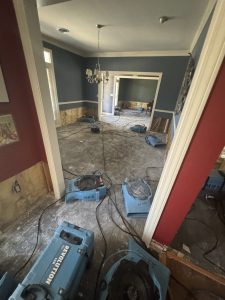 and with one to two inches of standing water throughout most of the home, the clock was ticking. In an uncontrolled environment, you have a very narrow window to remove that moisture before mold begins to develop.” Because the property still had no power, the crew brought in a large pull-behind trailer generator to run 40 high-velocity fans, eight commercial dehumidifiers, and air filtration systems. Dustin explained that the heavy equipment is a necessity, even if it feels overwhelming to a homeowner. “Homeowners are often surprised by the number of air movers and dehumidifiers needed after a major water loss. It may seem excessive, but when you have that much moisture in an uncontrolled environment, the conditions are ideal for mold growth. Structural drying is a science, and the goal is to remove moisture from the building materials completely so there are no hidden problems later.”
The power stayed out in that neighborhood for about two weeks. By acting fast and running the generator, they kept moisture from trapping behind cabinets and walls,
saving the insurance company tens of thousands of dollars in long-term mold
remediation. To track the damage, Dustin’s team used digital moisture meters and a 3D mapping tool to take 360-degree scans before, during, and after the demo. Dustin noted that their main priority during this phase is simply keeping everyone on the same page: “One of our most important roles is bridging the information gap between the homeowner and the insurance company. Most homeowners have never dealt with a major insurance claim, so we document every stage of the process and make sure everyone understands what is happening. Clear communication and thorough documentation are the keys to keeping a claim moving.”
Packing Up the House and Moving the Piano
The project required a massive pack-out, utilizing 20 to 30 people at any given time. A demo crew of 10 to 12 guys tore out the wet sheetrock, trim, insulation, carpets, and ruined original hardwood floors, while a separate
 contents crew of 10 to 12 people packed up and stored about 70% of the family’s personal belongings. One of the trickiest items in the house was the family’s piano, which was sitting right in the flood zone. Dustin emphasized that unique items like this require specialized care: “A piano has to be handled very differently from ordinary household contents. It cannot simply be wrapped, loaded onto a truck, and placed in storage. That is why we partner with specialty vendors such as Lane Music in Memphis. They know how to secure the keys and internal components, transport it properly, and store it in a controlled environment.”
It took about three to four weeks to get the official repair approval from State Farm,
which Dustin says is common for a major catastrophe event when local resources are
stretched thin. The actual reconstruction work started around March 1st and took two months, meaning the Littles were displaced for about three and a half months total from start to finish. While insurance only pays to replace what was originally there with equal quality, the process requires decisions about what gets put back into the home.
Putting the pieces together
“Larry and I have been in this house 33 years, and we were very happy with the way it was. I had to make decisions about new floors, new paint colors, and Dustin was very accommodating.” Dustin said “The Littles were absolutely wonderful to work with. I would not call the project a remodel because our responsibility was to restore what had been damaged, but the process gave them an opportunity to update and refresh portions of their home. They made their flooring, cabinet, and paint selections before reconstruction began, which helped us keep the project on schedule.
“We take pride in being there from the initial emergency response through the final walk-through. Guiding a family through one of the most stressful events of their lives and then handing back a safe, dry, beautifully restored home where they can begin making new memories is what makes this work rewarding.”
SIDE BAR
Dustin’s top advice for avoiding a post-disaster headache:
● The Annual Check-in: Sit down with your insurance agent every year to review
what is covered and what is excluded. Cheaper isn’t always better.
● Document Everything: Once a year, take your phone and snap photos or
videos of every room, closet, and valuable item. If disaster strikes, it helps prove
the value of your belongings and shows contractors exactly how to rebuild your
custom trims or wallpaper.
● Watch the Upgrades: If you’ve recently remodeled your kitchen or built a
backyard “She-Shed” make sure to increase your coverage limits to reflect
today’s rising labor and material costs.